
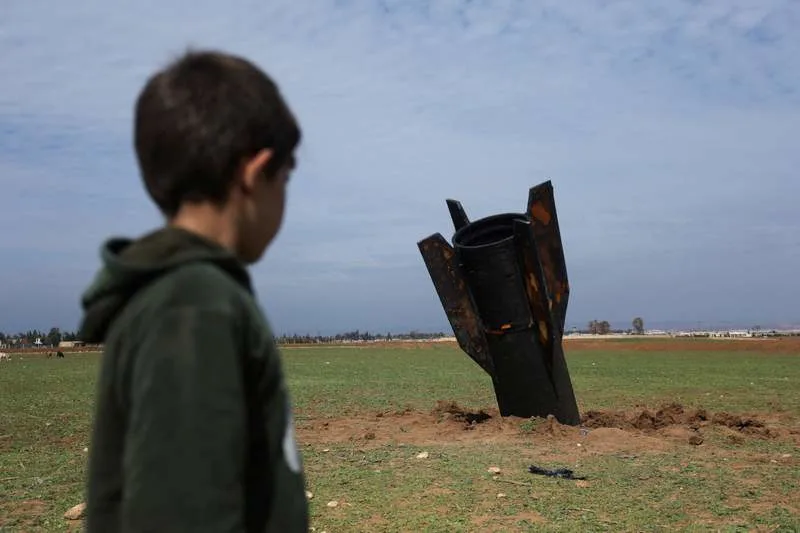
Syria attempting to avoid regional conflict, Iran war as it navigates internal strife
Syria, now led by a new government headed by Syrian President Ahmed al-Sharaa, has only recently emerged from a decade-long civil war following the fall of the Assad regime in December 2024.
As much of the Middle East has been plunged into chaos and conflict by the war in Iran, Syria is one country trying to stay out of the fighting.
Syria has only recently emerged from a decade-long civil war following the fall of the Assad regime in December 2024. It is now led by a new government headed by Syrian President Ahmed al-Sharaa.
On Friday, Sharaa sent congratulatory cables marking the Islamic holiday of Eid al-Fitr to a number of Arab and Islamic leaders. Syrian state-owned outlet Syrian Arab News Agency (SANA) said the cables were sent as “part of strengthening bilateral relations and exchanging congratulations on religious occasions.”
Sharaa reached out to a long list of countries, including Saudi Arabia, Qatar, Iraq, Oman, Algeria, Palestine, Yemen, Mauritania, Azerbaijan, Pakistan, Afghanistan, Malaysia, Tanzania, Bahrain, Kuwait, Indonesia, Jordan, the United Arab Emirates, Morocco, Somalia, Egypt, Tunisia, Turkey, Nigeria, and Uzbekistan. He also sent a message to the Kurdistan Region of northern Iraq.
“The messages underscored Syria’s commitment to strengthening ties with these countries and conveyed hopes for continued cooperation and solidarity across the region,” SANA noted.
Sharaa appears keenly aware of the region’s challenges. In southern Syria, Iranian missiles launched at Israel can sometimes be seen from the ground as they pass overhead. At the same time, Israel is at war with Hezbollah in neighboring Lebanon. Syria also has tensions with Hezbollah, which backed the Assad regime and tried to occupy parts of Syria during the civil war.
Sharaa has sought to put Syria on a path toward peace and prosperity. He was quick to reach out to US President Donald Trump in 2025, with support from Saudi Arabia and Turkey, two countries that have close ties to the White House. He has also been able to get sanctions removed on Syria so it can attract investment. Sharaa is positioning Syria as a country seeking peace, not conflict, in a region where conflict appears to be spreading.
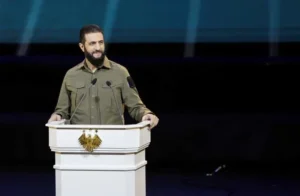
On Friday, during a speech given at the People’s Palace in Damascus, Sharaa asserted that “Syria’s economy is rebounding sharply after years of decline,” according to SANA, citing a budget surplus and projections that GDP will return to pre-war levels as reconstruction and wage increases accelerate.
“Everyone knows that the situation had deteriorated, and in numbers, the GDP in 2010 was $60 billion, then things deteriorated, and after liberation, statistics indicated that it had decreased significantly,” he noted. “In 2025, we achieved a growth rate of approximately 30 to 35 percent, with GDP reaching around $32 billion and spending reaching $3.5 billion. For the first time in Syria, there was a budget surplus,” he said.
The Syrian state is increasing its budget as GDP rises rapidly. Sharaa additionally stressed that the state has priorities, including ending the issue of refugee camps and enabling people to return to their villages and towns destroyed by the deposed regime, SANA noted.
To make sure that growth reaches ordinary Syrians, the government is raising public-sector salaries by 50%. Sharaa has also introduced tax exemptions for businesses hit by the war, with exemptions varying depending on the extent of damage. Commercial businesses will receive tax relief for one year, ranging from 50 percent for damage between 25 and 50 percent, to full exemption for damage exceeding 75 percent of the business, SANA reported.
Syria remains in transitional state
However, Syria still faces serious challenges. It recently completed a series of transitions in eastern Syria, where areas formerly run by the Syrian Democratic Forces were integrated into state-run areas. The Interior Ministry in Damascus has sent forces to work with the SDF to secure those areas. Still, there are places where the transfer of control has not gone smoothly, such as the Kurdish city of Kobani in northern Syria.